Physical Address
The Woodlands, TX, USA
Physical Address
The Woodlands, TX, USA

Welcome to the official research platform for traditional topocentric astronomy. Here, we delve into the epistemological, philosophical, and physical foundations of the celestial sphere. We treat astrology not as the commercialised abstraction found in contemporary horoscope columns, but as it was originally conceived: a rigorous discipline rooted in observable celestial mechanics.
Our Distinction and Focus
The authentic practice of traditional astrology spans the astronomical achievements from Ptolemy in the 2nd century to Morin de Villefranche in the 17th century. We draw a sharp and explicit distinction between this foundational era and the popular distortions that emerged during the industrial revolutions of the 19th and 20th centuries. Our work is dedicated to exploring the topocentric computational mathematics necessary for the accurate construction of the celestial map (hōroskopos, or “hour-marker”). We echo the intellectual rigour applied by the architects of our discipline—figures such as Abraham ibn Ezra, Campanus of Novara, Regiomontanus, Johannes Kepler, Tycho Brahe, and Placidus de Titis.


Methodology and Respect for Physics
Our methodology is strictly governed by an uncompromising respect for the physical basis of the astrological symbol. The symbolic language we employ is never imposed arbitrarily; it constitutes the allegorical expression of astrophysics. For instance, the Sun represents vitality because it is the literal source of life; Uranus, with its extreme 98º axial tilt, signifies anomalies rather than conventions; and Venus, possessing a uniform climate and virtually no axial tilt, represents equilibrium rather than chaos. We operate on the premise that observable and measurable astronomical realities—geometry, kinematics, and physical relationships—must serve as the sole foundation for celestial inference. («As above, so below.»)
Recent Breakthrough: The Geometric Accountability of House Systems
Our platform has prompted a major methodological review within the traditional community, beginning with the publication of our foundational quantitative study: “Astronomical Fidelity in Historical Coordinate Systems of Celestial Partitioning” (Nov. 2025).
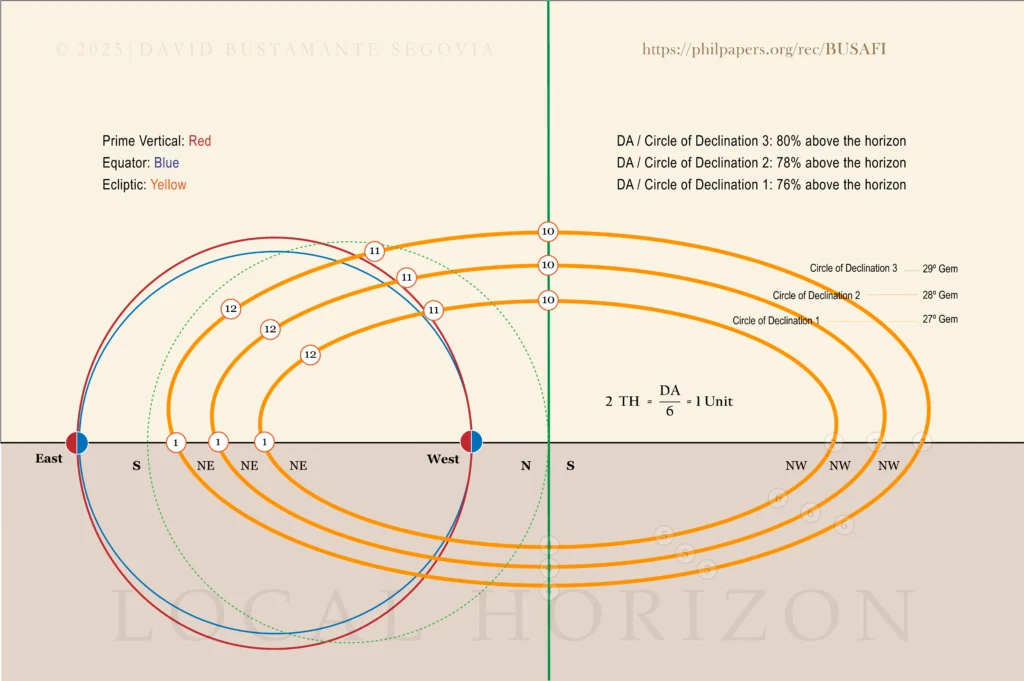
Made available on PhilArchive with foundational datasets hosted on Zenodo to invite strict academic scrutiny, this initial work isolated the mechanism of action responsible for the mathematical flaw in all static, linear methods of celestial partition, ranging from Alcabitius to Koch. By exhaustively quantifying the spatiotemporal discrepancies (Δt) across these methods against the actual length of diurnal arcs (confirmed by modern computational geometry), we demonstrated that they impose an arbitrary spatial structure onto a non-arbitrary kinematic phenomenon.
Building upon this rigorous foundation, our subsequent forensic analysis was accepted and published as Kinematic Fidelity in Celestial Partitioning: A Topocentric Audit in the peer-reviewed Correlation Journal (Vol. 38, Issue 2, Summer 2026). Now archived on our platform under the expanded title The Geometry of Antiquity: How Apparent Diurnal Motion Resolves the Hellenistic Hour Markers, this paper subjected intermediate cusps to the strict metrology of the Solar Footprint Test. The peer-reviewed record formally conceded the geometric accuracy of these calculations, establishing that true proportional diurnal motion, the actual natural geometry of an Asc and a MC, cannot be dismissed as a discretionary convention.
Collectively, this research scientifically confirms that the Ptolemaic-Placidian method of celestial partitioning constitutes the sole natural, isochronous, and complete topocentric system—a conclusion that continues to compel a rigorous re-examination of foundational astrological practice by peers and institutions alike (Kampherbeek, J., 2025-11-11; Experimental Astrology, 2025-11-28).